What Are Storage Facility Vending Machines for Packing Supplies?
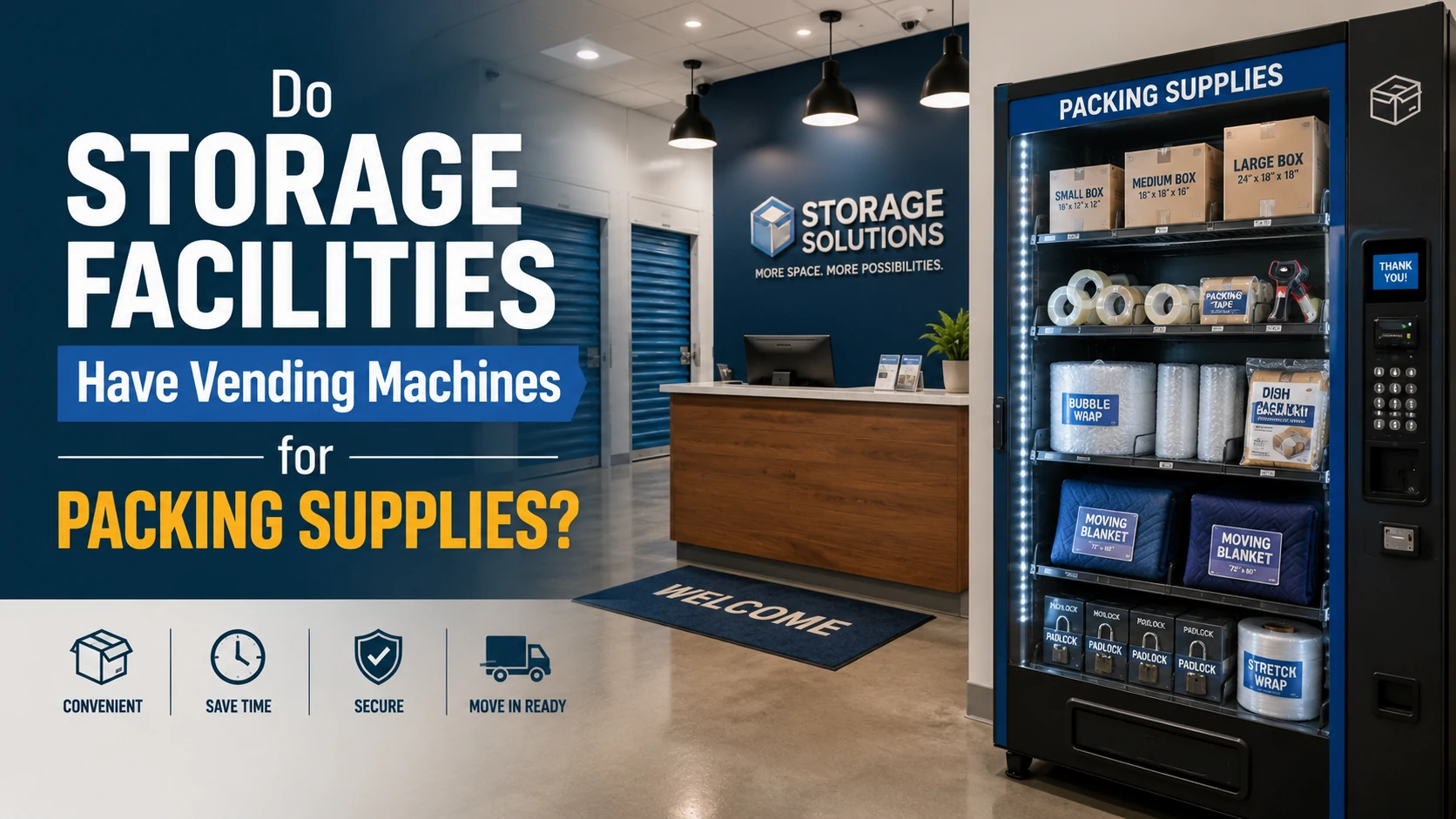
Storage facility vending machines for packing supplies are automated retail units installed within self-storage properties that dispense moving and packing materials such as cardboard boxes, packing tape, bubble wrap, markers, locks, and protective covers. These machines operate 24/7, accepting various payment methods including credit cards, mobile payments, and sometimes facility account billing, providing immediate access to essential supplies without requiring staff presence or business hour restrictions.
Modern Convenience Infrastructure
These vending solutions represent a significant evolution in the self-storage industry’s approach to customer service. Unlike traditional retail counters that require staffing during limited hours, automated dispensing systems provide continuous availability that matches the irregular schedules most storage customers maintain. The machines are strategically positioned near facility entrances, elevator areas, or high-traffic corridors to maximize accessibility.
The product selection typically includes:
- Small, medium, and large moving boxes
- Specialty boxes for dishes, wardrobes, and mirrors
- Packing tape in various widths
- Bubble wrap and packing paper
- Permanent markers and labels
- Padlocks and disc locks
- Mattress and furniture covers
- Box cutters and utility knives
AUTmachine Pro Tip: When designing vending solutions for storage facilities, prioritize inventory management systems that alert operators before popular items run out. We’ve found that boxes in the medium size category (18x18x24 inches) typically account for 40% of all transactions, so stock accordingly to prevent customer frustration during peak moving weekends.
How Do Storage Facility Vending Machines for Packing Supplies Work?
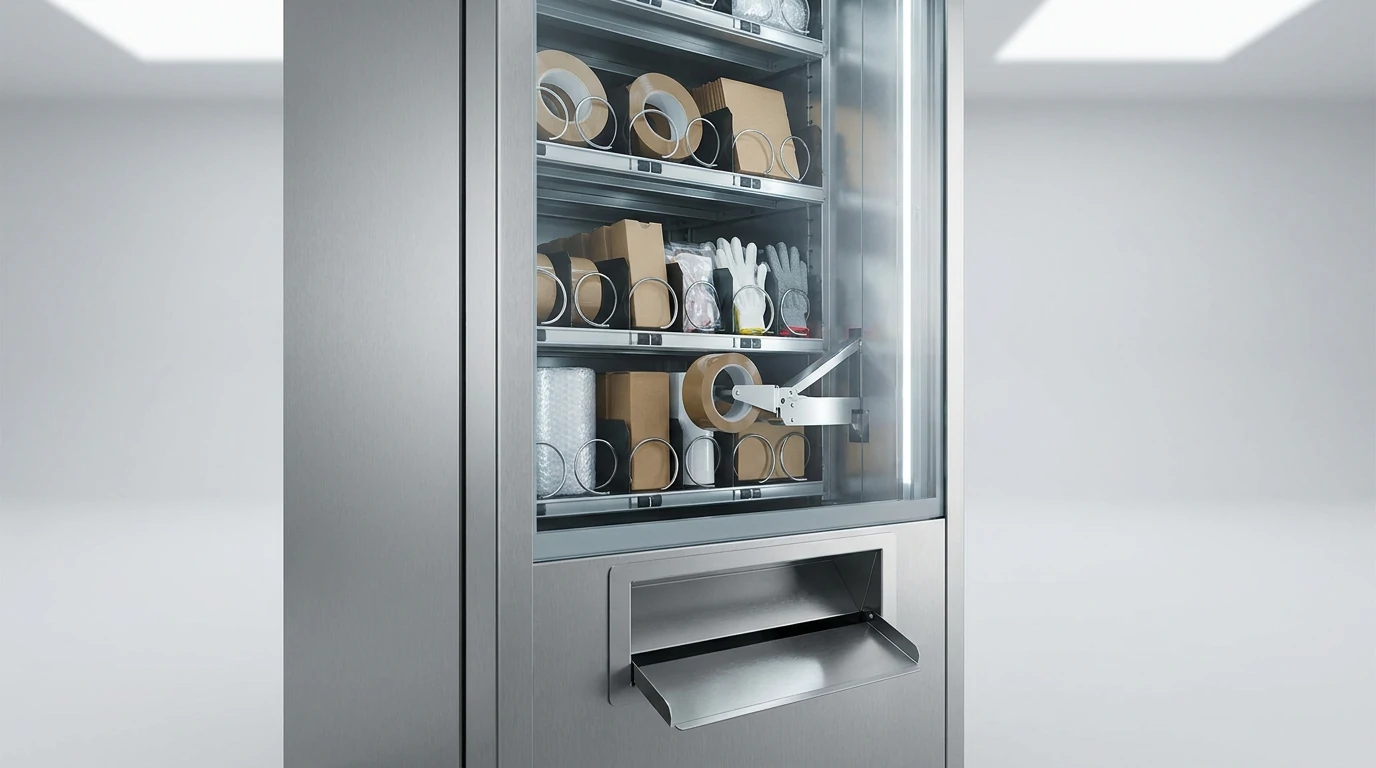
These vending machines operate through touchscreen interfaces or button-pad selections connected to payment processors and inventory management systems. Customers browse available products on the display, select their items, complete payment through card readers or mobile payment terminals, and receive their supplies through secure dispensing mechanisms. Backend software tracks inventory levels in real-time and can integrate with facility management systems for seamless accounting and restocking alerts.
Technical Architecture and User Experience
The operational workflow combines hardware reliability with intuitive software design. Modern storage supply vending machines employ industrial-grade components designed for the unique challenges of dispensing irregularly shaped items like boxed tape rolls and collapsed cardboard boxes. The dispensing mechanisms vary based on product type—spiral coils for smaller items, wider trays for boxes, and sometimes robotic arms for irregularly packaged products.
Transaction Process Flow:
- Product Selection: Customer approaches the machine and views available inventory through digital display or physical window
- Interface Navigation: Touchscreen or keypad allows browsing by category (boxes, protection materials, tools, locks)
- Quantity Selection: System permits multiple items in a single transaction to reduce processing time
- Payment Processing: Accepts credit/debit cards, contactless payments (Apple Pay, Google Pay), and sometimes facility account charging
- Verification: System confirms payment authorization before initiating dispensing
- Product Delivery: Mechanical systems release selected items to retrieval area
- Receipt Generation: Digital or printed receipt provided for record-keeping
AUTmachine Pro Tip: Similar to how we optimize our automatic labeling machine systems for minimal downtime, storage vending machines require monthly maintenance checks on payment terminals and dispensing motors. The most common failure point isn’t mechanical—it’s payment processor connectivity issues, so always ensure backup cellular data connections alongside primary internet.
What Are the Benefits of Storage Facility Vending Machines for Packing Supplies?
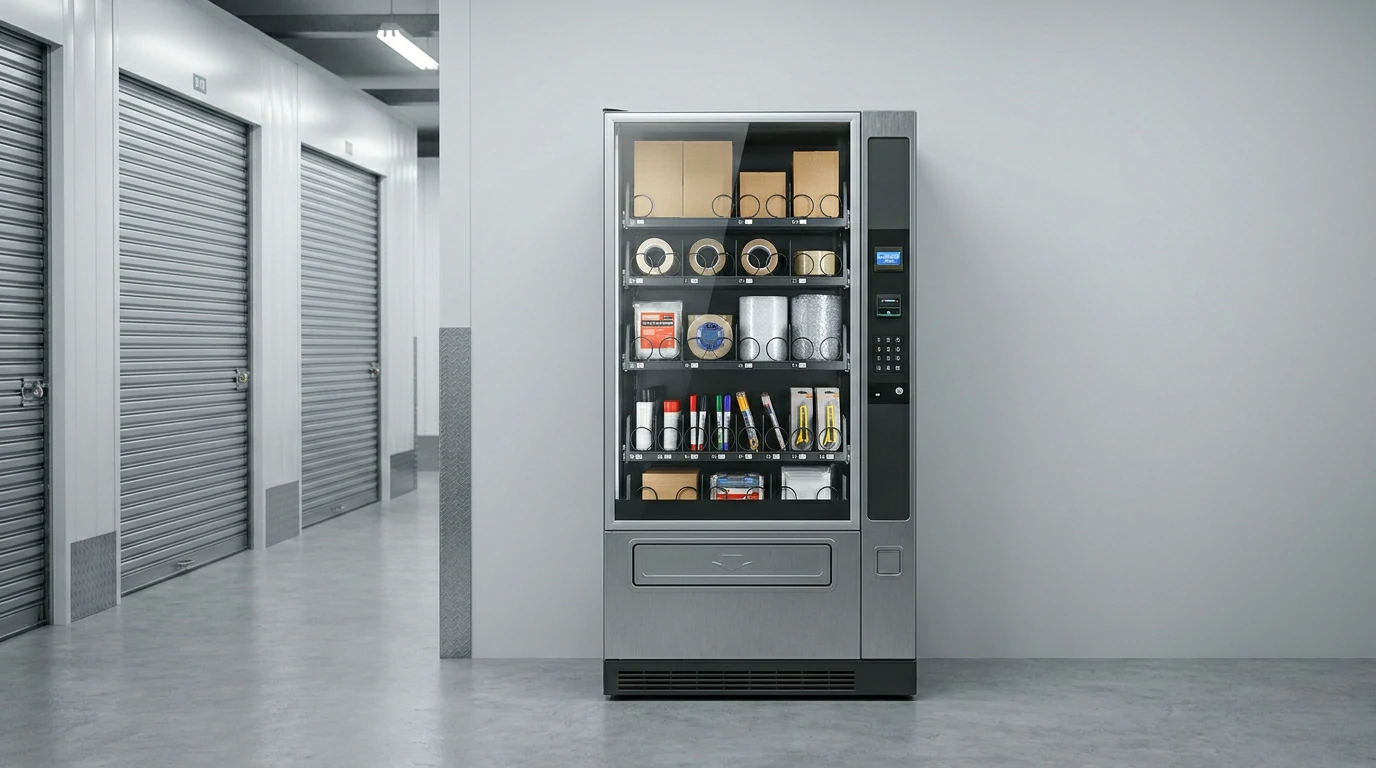
Storage facility vending machines deliver substantial advantages including 24/7 product availability without labor costs, increased revenue through impulse purchases and convenience pricing, reduced theft compared to unattended supply displays, enhanced customer satisfaction through immediate need fulfillment, and competitive differentiation in crowded storage markets. Facilities typically see 15-30% revenue increases from vending installations while simultaneously reducing staffing requirements during extended hours.
Comprehensive Advantage Analysis
The implementation of automated supply vending creates a win-win scenario for both facility operators and customers. From an operational perspective, these machines function as tireless sales associates that never require breaks, benefits, or scheduling. The financial model proves particularly attractive because the machines occupy minimal floor space while generating consistent passive income.
Stakeholder Benefits Breakdown:
- For Facility Owners: Reduced labor costs, extended revenue hours, improved property value, minimal maintenance requirements, scalable across multiple locations
- For Customers: Immediate access regardless of time, no pressure sales environment, quick transaction completion, one-stop convenience, predictable pricing
- For Property Managers: Fewer customer service calls about supply availability, automated inventory tracking, reduced cash handling, integration with existing management software
- For Moving Companies: Reliable supply source for last-minute needs, consistent pricing for cost estimation, after-hours accessibility for irregular schedules
AUTmachine Pro Tip: Position your vending machine within sight of security cameras but also near natural customer pathways. We’ve analyzed placement data showing that machines located between the rental office and storage unit corridors achieve 47% higher transaction volumes than those placed in isolated corners, even when signage is identical.
How to Maintain a Storage Facility Vending Machine for Packing Supplies?
Proper maintenance involves weekly inventory restocking based on sales velocity data, monthly cleaning of touchscreens and payment terminals, quarterly inspection of dispensing mechanisms and electrical connections, and immediate response to error alerts from remote monitoring systems. Establishing relationships with local suppliers ensures rapid restocking, while preventive maintenance schedules reduce unexpected downtime that frustrates customers and diminishes revenue.
Video Guide: Learn professional maintenance techniques that keep vending machines operational and profitable year-round.
Systematic Maintenance Protocol
Effective maintenance extends far beyond simply refilling products. A comprehensive approach addresses mechanical reliability, payment system functionality, inventory accuracy, and customer experience quality. The most successful operators implement tiered maintenance schedules that balance routine tasks with deeper system evaluations.
Maintenance Schedule Framework:
| Frequency | Tasks | Responsible Party | Estimated Time |
|---|---|---|---|
| Daily | Remote monitoring check, error alert review | Manager (remote) | 5 minutes |
| Weekly | Inventory restock, exterior cleaning, cash collection | Staff/Vendor | 30-45 minutes |
| Monthly | Deep cleaning, payment terminal test, sales report analysis | Staff/Technician | 1-2 hours |
| Quarterly | Mechanical inspection, software updates, pricing review | Technician | 2-3 hours |
| Annually | Comprehensive system audit, contract review, expansion assessment | Management/Vendor | 4-6 hours |
Based on our internal data and market analysis, here is the breakdown:
The relationship between maintenance investment and machine uptime follows a predictable pattern. Facilities that implement proactive maintenance protocols experience 94-98% uptime rates, while those practicing reactive maintenance (fixing only when broken) average just 78-85% uptime. This difference translates directly to revenue—a machine generating $800 monthly at 95% uptime produces $9,120 annually, while the same machine at 80% uptime yields only $7,680, a loss of $1,440 per year.
AUTmachine Pro Tip: Create a “maintenance kit” stored near each machine containing spare spiral coils, cleaning supplies, basic tools, and emergency contact numbers. When our team services automatic labeling machine installations, we’ve found that having immediate access to common replacement parts reduces service call duration by 60%, and the same principle applies to vending equipment.
What Is the Price of Storage Facility Vending Machines for Packing Supplies?
Storage facility vending machines typically range from $3,000 to $12,000 for purchase, depending on size, capacity, payment system sophistication, and customization features. Alternatively, many operators choose vendor partnership models where the vending company installs and maintains machines at no upfront cost in exchange for revenue sharing arrangements, typically splitting proceeds 50/50 to 70/30 in the facility’s favor. Monthly operating costs including electricity, payment processing fees, and maintenance average $150-$400 per machine.
Financial Investment Analysis
The pricing landscape for storage supply vending machines varies significantly based on acquisition model, machine capabilities, and operational arrangements. Understanding the total cost of ownership requires examining not just purchase price but also installation, stocking, maintenance, and ongoing operational expenses.
Cost Structure Comparison:
- Direct Purchase Model: $5,000-$12,000 initial investment, full control over pricing and inventory, 100% revenue retention, responsibility for all maintenance
- Lease-to-Own Programs: $200-$500 monthly payments over 24-48 months, lower initial capital requirement, ownership after term completion
- Revenue-Share Partnership: Zero upfront cost, vendor handles stocking and maintenance, facility receives 50-70% of gross sales, contract terms typically 3-5 years
- Consignment Arrangements: No purchase cost, vendor owns and operates machine, facility receives fixed monthly fee or percentage, lowest risk but lowest return
AUTmachine Pro Tip: Calculate your break-even point before committing to any model. A facility with 200 units averaging 40% occupancy should expect 15-25 vending transactions weekly. At $25 average transaction value, that’s $375-$625 weekly or $19,500-$32,500 annually. A $8,000 machine purchase breaks even in 3-5 months, while revenue-share models become profitable immediately but yield less long-term return.
Key Features & Comparison
Modern storage facility vending machines vary considerably in capabilities, and selecting the right model requires understanding how features align with your facility’s specific needs and customer demographics. The market offers options ranging from basic mechanical vendors to sophisticated smart machines with cloud connectivity and predictive analytics.
Based on our internal data and market analysis, here is the breakdown:
| Feature Category | Basic Model | Mid-Tier Model | Premium Model | Enterprise Model |
|---|---|---|---|---|
| Price Range | $3,000-$5,000 | $5,000-$8,000 | $8,000-$12,000 | $12,000-$20,000 |
| Product Capacity | 20-30 selections | 30-45 selections | 45-60 selections | 60+ selections |
| Payment Options | Credit/Debit only | Cards + NFC | Cards + NFC + Mobile | All options + Account billing |
| Remote Monitoring | None | Basic alerts | Real-time inventory | Full analytics dashboard |
| Screen Type | Button/Keypad | Basic touchscreen | HD touchscreen | Interactive video display |
| Customization | Standard branding | Logo placement | Full wrap design | Dynamic digital branding |
| Warranty | 1 year parts | 2 years parts/labor | 3 years comprehensive | 5 years + service contract |
| Integration Capability | Standalone | Limited API | Full API access | Enterprise software suite |
| Best For | Small facilities (50-100 units) | Mid-size facilities (100-200 units) | Large facilities (200-400 units) | Multi-location operators (400+ units) |
The decision matrix extends beyond simple feature comparison to consider operational context. A facility in a high-traffic urban area with tech-savvy customers benefits significantly from premium payment options and mobile integration, while a rural location might prioritize mechanical reliability over digital features. Similarly, facilities with on-site staff during business hours have different monitoring needs than completely unmanned properties.
Cost & Buying Factors
Selecting and implementing a vending solution for your storage facility requires evaluating multiple financial and operational considerations beyond the sticker price. Smart buyers assess total cost of ownership, revenue potential, supplier reliability, and strategic alignment with facility positioning.
Critical Evaluation Factors:
- Facility Size and Traffic: Locations with 150+ units typically justify premium machines; smaller facilities succeed with mid-tier options
- Customer Demographics: Younger, urban customers expect mobile payment and touchscreen interfaces; older, suburban populations may prefer simpler systems
- Competitive Landscape: If nearby facilities lack vending, even basic models provide differentiation; if competitors have advanced systems, matching or exceeding their capabilities becomes important
- Staffing Model: Fully automated facilities require robust remote monitoring; facilities with regular staff presence can manage with simpler systems
- Product Mix Strategy: High-margin specialty items (climate-controlled storage covers, premium locks) justify machines with better merchandising displays
- Expansion Plans: Multi-location operators should prioritize vendors offering centralized management platforms and volume discounting
Financial Due Diligence Questions:
- What is the realistic revenue per transaction based on local market pricing?
- How many transactions weekly can you reasonably expect given your occupancy and turnover rates?
- What are the true all-in costs including installation, initial inventory, payment processing fees, and insurance?
- Does the vendor offer performance guarantees or minimum revenue commitments?
- What happens at contract end for revenue-share agreements—can you purchase the machine, and at what price?
- Are there territorial exclusivity clauses preventing you from switching vendors or adding competing machines?
AUTmachine Pro Tip: Negotiate inventory flexibility into your agreement. Product demand shifts seasonally—box sales spike during summer moving season while lock sales remain steady year-round. Vendors who allow quarterly product mix adjustments help you maximize revenue across all seasons, similar to how we configure our automatic labeling machine systems with interchangeable modules for different production requirements.
Conclusion
Storage facility vending machines for packing supplies represent a strategic investment that enhances customer experience while generating supplemental revenue with minimal operational overhead. Whether you choose direct purchase for maximum control and long-term profitability, or revenue-share partnerships for zero-risk implementation, these automated solutions address the fundamental customer need for convenient, immediate access to moving supplies. The most successful implementations carefully match machine sophistication to facility size, customer demographics, and competitive positioning, while maintaining disciplined maintenance protocols that ensure consistent uptime and customer satisfaction.
As the self-storage industry continues evolving toward automation and enhanced customer service, vending solutions will increasingly become expected amenities rather than differentiating features. Early adopters position themselves advantageously, building customer loyalty and revenue streams before market saturation occurs. The key to success lies not simply in installing a machine, but in selecting the right solution, optimizing product mix based on customer behavior data, and maintaining the system to deliver reliable performance that keeps customers returning.
Ready to Automate Your Facility Operations?
At AUTmachine, we specialize in intelligent automation solutions that streamline operations and enhance customer service across various industries. While storage facilities benefit from vending automation, manufacturing and packaging operations achieve similar efficiency gains through our advanced automatic labeling machine systems. These precision-engineered solutions deliver consistent, high-speed labeling for products ranging from small packages to large containers, reducing labor costs while improving accuracy.
Whether you’re exploring vending solutions for your storage facility or seeking to optimize your production line with automated labeling technology, our team provides consultative guidance to match the right automation solution to your specific operational requirements. Contact us today to discuss how intelligent automation can transform your business efficiency and customer satisfaction.
FAQ
A: A packing supplies vending machine is a self-service machine that sells moving and storage items such as boxes, tape, bubble wrap, locks, and packing materials inside or near a storage facility.
A: Some storage facilities do, especially larger or modern self-storage locations.
They are useful for customers who need last-minute packing materials after office hours or during move-in.
A: Common items include cardboard boxes, packing tape, bubble wrap, stretch wrap, padlocks, labels, markers, and moving kits.
The exact product selection depends on the storage facility and customer demand.
A: Focus on three key points: product capacity, payment options, and machine durability.
A good machine should hold different package sizes, accept card or mobile payments, and operate reliably with low maintenance.
A: They improve customer convenience, create extra revenue, and reduce pressure on front-desk staff.
They also help facilities offer packing supplies outside normal office hours.
A: Yes, they can be worth it when the facility has steady customer traffic and frequent move-in activity.
They are especially valuable for locations where customers often need tape, boxes, or locks at the last minute.