Skip to content
In modern electrical power distribution and heavy industrial panel fabrication, busbar systems serve as the core backbone for conducting current through switchgear, transformers, substations, and control cabinets. As global demands for energy transition, smart grids, and high-density power systems grow, conventional manual or semi-automated busbar fabrication techniques have become major bottlenecks. Traditional methods often suffer from high material scrap rates, dimensional inconsistencies, and labor-intensive assembly processes.
To meet strict international technical standards—such as IEC 61439 for low-voltage switchgear assemblies—manufacturers are increasingly integrating modern busbar machine technology into their automated production lines.

This article explores the technical applications of CNC multi-station busbar processing equipment in power switchgear manufacturing and provides a structured engineering selection guide for industrial buyers.
Technical Applications of CNC Busbar Processing in Switchgear Manufacturing
The manufacturing of high- and low-voltage electrical switchboards requires working primarily with high-conductivity electrolytic copper (E-Cu) and aluminum (E-Al) busbars. These non-ferrous metals demand precise mechanical cold-forming processes to prevent localized stress concentration, micro-cracking, or contact surface degradation.

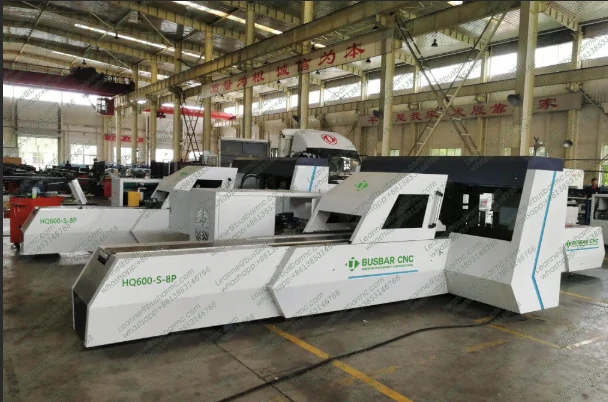
Modern CNC busbar processing machinery performs three core operations—punching, shearing, and bending—often in a synchronized, multi-station architecture.
1. High-Precision Punching
Busbars require various hole geometry configurations (round, oblong, square, countersunk) for bolting connections and mounting insulators. A dedicated busbar punching machine station utilizes a rotary turret or multi-die positioner.

- Turret System Integration: Allows automatic switching between 4 to 8 punch sets without manual tool changes, significantly reducing setup time.
- Shear-Stress Control: Ensures hole edges are clean and free of burrs, preventing localized hot spots caused by imperfect electrical contact surfaces.
2. Burr-Free Shearing and Cutting
Precision cutting directly impacts joint fitting tolerances. CNC shearing units utilize single-column or double-column guided shear blades with flat-edge blade geometry.

- Material Savings: Advanced CNC feeding systems optimize the cutting sequence, achieving near-zero scrap loss between cuts.
- Surface Integrity: Single-blade shearing eliminates waste chips while preventing edge collapse or deformation, ensuring flush mating against breaker terminals.
3. Closed-Loop CNC Bending (Flat, Vertical, and Twisting)
Bending affects the physical properties and resistivity of copper bars. CNC bending units use closed-loop digital control systems with photo-electric encoders to measure exact bending angles (0° to 180°).

- Springback Compensation: Automatic material thickness and springback calculations ensure angle repeat accuracy within ±0.3°.
- Multi-Type Bending: Capable of executing horizontal/flat bends, vertical bends, Z-bends, and 90° twist bends required for compact substation cabinet routing.
Engineering Selection Analysis for Electrical Cabinet Manufacturers
Selecting the right CNC busbar machine depends on production capacity, maximum copper thickness, workpiece dimensions, and automation requirements.
| Key Parameter / Feature | Small-Scale Panel Shop | Industrial Switchgear Plant | Automated OEM Line |
|---|---|---|---|
| Max Processing Thickness | Up to 10 mm (Copper) | 16 mm ~ 20 mm | 16 mm ~ 25 mm |
| Max Busbar Width | 120 mm ~ 160 mm | 200 mm ~ 250 mm | 250 mm + |
| Machine Architecture | 3-in-1 Combined Unit | 3 Independent Hydraulic Stations | Full CNC Automatic Line with Feed System |
| Bending Accuracy | ±0.5° (Manual Stop) | ±0.3° (CNC Servo Control) | ±0.1° (Closed-Loop Optical Encoder) |
| Punching Mechanism | Single-Die Change | 6-Station Turret | 8/12-Station Turret + Auto Loader |
Key Technical Criteria to Evaluate Before Purchase:
- Simultaneous Multi-Station Operation: Ensure the machine features independent motors and hydraulic pumps for punching, shearing, and bending so three technicians can operate the unit simultaneously without pressure interference.
- CNC Control System & Software: Look for PLC-based or industrial PC controls featuring touchscreen CAD/CAM graphical interfaces. The system should automatically calculate bend deduction and unfolding lengths based on material grade.
- Hydraulic System Stability: High-pressure hydraulic circuits (70 MPa) equipped with cooling fans or oil chillers ensure consistent punch tonnage and angle accuracy during continuous 24/7 industrial operation.
Conclusion & Manufacturer Technical Support
Transitioning from manual copper busbar processing to a modern CNC multi-station workflow reduces processing times by over 60%, minimizes expensive copper raw material waste, and guarantees compliance with global electrical insulation tolerances.
For technical inquiries, customized busbar machinery solutions, machine tool selection, or product documentation, please reach out directly to the LTMC engineering team:
Contact & Inquiries
- Official Website: https://busbarmc.com
- E-mail: Leanne@busbarmc.com
- WhatsApp: +86 138 5314 6766
- WeChat: +8613853146766